
Neurofeedback Sounds Like Science Fiction. It Isn’t.
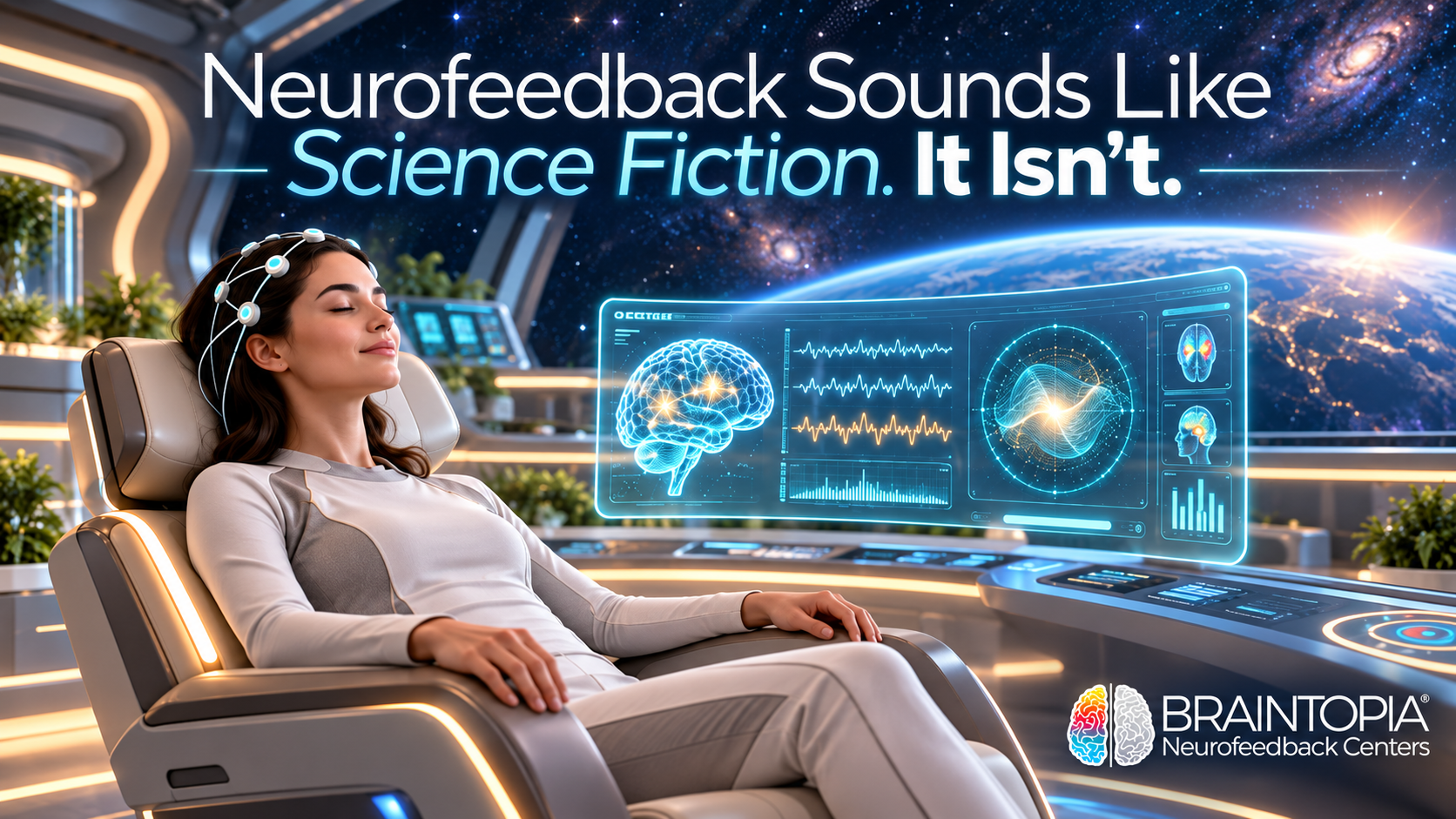
September brings Star Trek Day, making it the perfect time to talk about a modern wellness technology that still sounds like pure science fiction.
Imagine sitting comfortably in an armchair while gentle sensors monitor your brain’s electrical activity in real time. A computer instantly analyzes patterns in that activity and provides feedback that helps your brain self-correct and learn.
No surgery.
No electricity being sent into your brain.
No Vulcan mind melds.
And unfortunately, we still can’t beam anybody up.
What we can do is something that would have sounded pretty futuristic not that long ago: we can listen to the brain.
Key Takeaways: Neurofeedback at a Glance
Listening, Not Transmitting: Neurofeedback uses passive scalp sensors that act like tiny microphones to measure natural electrical patterns. It never puts electricity, signals, or pulses into the brain.
Natural Learning Through Video Feedback: By simply watching a video that responds in real time to your brainwave patterns, the brain naturally learns to self-regulate without conscious strain or effort.
Over 50 Years in the Making: While reading brainwaves sounds futuristic, the science began in the 1960s; modern computing has simply made the technology comfortable, seamless, and accessible.
Comfortable & Flexible: Sessions are relaxing and non-invasive, with options to train in person at Braintopia or right from the comfort of your living room with our in-home equipment.
How Does Neurofeedback Work? Your Brain Is Always Sending Signals
Every second, billions of neurons in your central nervous system communicate with one another. This continuous communication creates measurable electrical patterns known as brainwaves.
During a neurofeedback session:
Passive Sensors: Small, non-invasive sensors are placed gently on your scalp.
Listening Only: These sensors act like tiny microphones—they do not send energy into the brain; they simply measure what is already happening.
Real-Time Processing: At Braintopia, specialized software translates those electrical patterns into cues while you relax and watch a video.
Dynamic Feedback: As your brain activity shifts toward more balanced patterns, the video responds immediately, giving your brain real-time feedback.
That is where neuroplastic learning begins.
The Feedback Loop: How the Brain Naturally Learns
Think about how you learn any physical skill. You shoot a basketball, watch where it hits the rim, and your nervous system automatically adjusts your posture and release for the next shot. The same mechanism applies to learning an instrument or mastering a golf swing.
Neurofeedback applies that feedback principle directly to brain activity:
Real-Time Data: Instead of tracking a physical ball, your brain receives continuous data about its own electrical patterns.
Pattern Recognition: Over repeated sessions, the brain learns to recognize and reinforce more regulated patterns of activity.
Subconscious Adaptation: You do not have to consciously force or calculate brainwave changes. Your brain's natural neuroplasticity does the heavy lifting.
No Mind Melds: Demystifying Brainwave Sensors
Because neurofeedback involves measuring brain activity, newcomers occasionally wonder if the technology reads thoughts.
Neurofeedback is not mind reading. The equipment cannot decipher your internal monologue, see your memories, or plant new ideas. It tracks broad patterns of electrical activity—frequencies that correlate with different mental and physical states—giving the system information about patterns of brain activity in that moment.
Why Train the Brain?
We routinely train almost every other area of our performance:
Athletes train muscle memory and cardiovascular stamina.
Musicians practice scales for dexterity and timing.
Pilots log hours in flight simulators to sharpen reaction times.
We train because repetition and consistent feedback make the human nervous system more efficient. Neurofeedback takes that established training principle and applies it directly to brain self-regulation.
At Braintopia Neurofeedback Centers, individualized brain training programs are designed to support:
Sustained attention and executive focus
Stress recovery and nervous system regulation
Healthy sleep patterns and relaxation
Emotional balance and cognitive resilience
The actual session is far calmer than Hollywood makes brain tech appear: you sit back comfortably, watch a video, and let your brain do what it was evolved to do—adapt and learn. In fact, we also offer in-home training options, providing you with the equipment so you can train your brain right in the comfort of your own living room.
Yesterday’s Science Fiction is Today’s Reality
While the concept might still sound futuristic, neurofeedback itself is far from new. Its scientific roots stretch back to the 1960s, the very same decade Captain Kirk first appeared on television screens.
Early pioneers demonstrated more than fifty years ago that the brain could learn to adjust its own electrical activity through simple feedback loops, and neurofeedback continues to be studied across a wide range of applications today.
What has changed dramatically is the technology delivering it. Decades of computing advancements have replaced early, complex lab setups with precision digital sensors, sophisticated signal processing, and clear, engaging video displays. Modern computing has simply made the process comfortable, seamless, and accessible.
We still do not have warp drive, and the Vulcan mind meld remains unavailable. But when it comes to observing how the brain functions and helping it practice better regulation, yesterday’s science fiction is a real technology you can experience today.
Ready to Explore Your Brain’s Potential?
You don’t have to wait for the 23rd century to explore how your brain can train and adapt. Contact Braintopia Neurofeedback Centers today to schedule an initial consultation and find out whether personalized neurofeedback—in our center or at home—is the right fit for your wellness goals.
Frequently Asked Questions (FAQ)
What is neurofeedback in simple terms?
Neurofeedback is a non-invasive brain training technique that measures real-time brainwave activity using scalp sensors. When your brain patterns move toward a more regulated state, specialized software provides immediate visual feedback on a screen, helping the brain learn to self-regulate through neuroplasticity.
Is neurofeedback an experimental or new technology?
Neurofeedback is not a new technology; its scientific roots stretch back more than 50 years to the late 1950s and 1960s. It continues to be researched and utilized across a wide variety of wellness and performance areas. Modern advancements have made today's sensors, software, and video displays far more comfortable, precise, and accessible.
Does neurofeedback put electricity or signals into the brain?
No. Neurofeedback sensors are completely passive; they only listen to and record naturally occurring electrical signals (EEG). No electrical current, magnetic pulse, or chemical substance is transmitted into the brain.
Can neurofeedback read my thoughts or memories?
No. Neurofeedback measures broad electrical frequencies and rhythms across regions of the scalp, not conscious thoughts, memories, or private emotions. The software observes patterns of brain activity without knowing what you are thinking.
Can I do neurofeedback training at home?
Yes. Braintopia provides convenient in-home training options with dedicated equipment, allowing you to complete your brain training sessions comfortably at home with remote guidance and support from our team.
Neurofeedback is a form of brain training, not a medical treatment, diagnosis, or cure. Individual results vary. Braintopia does not diagnose or treat medical or mental health conditions. This article is for education and is not a substitute for professional medical advice.
