
Beyond the Bangs
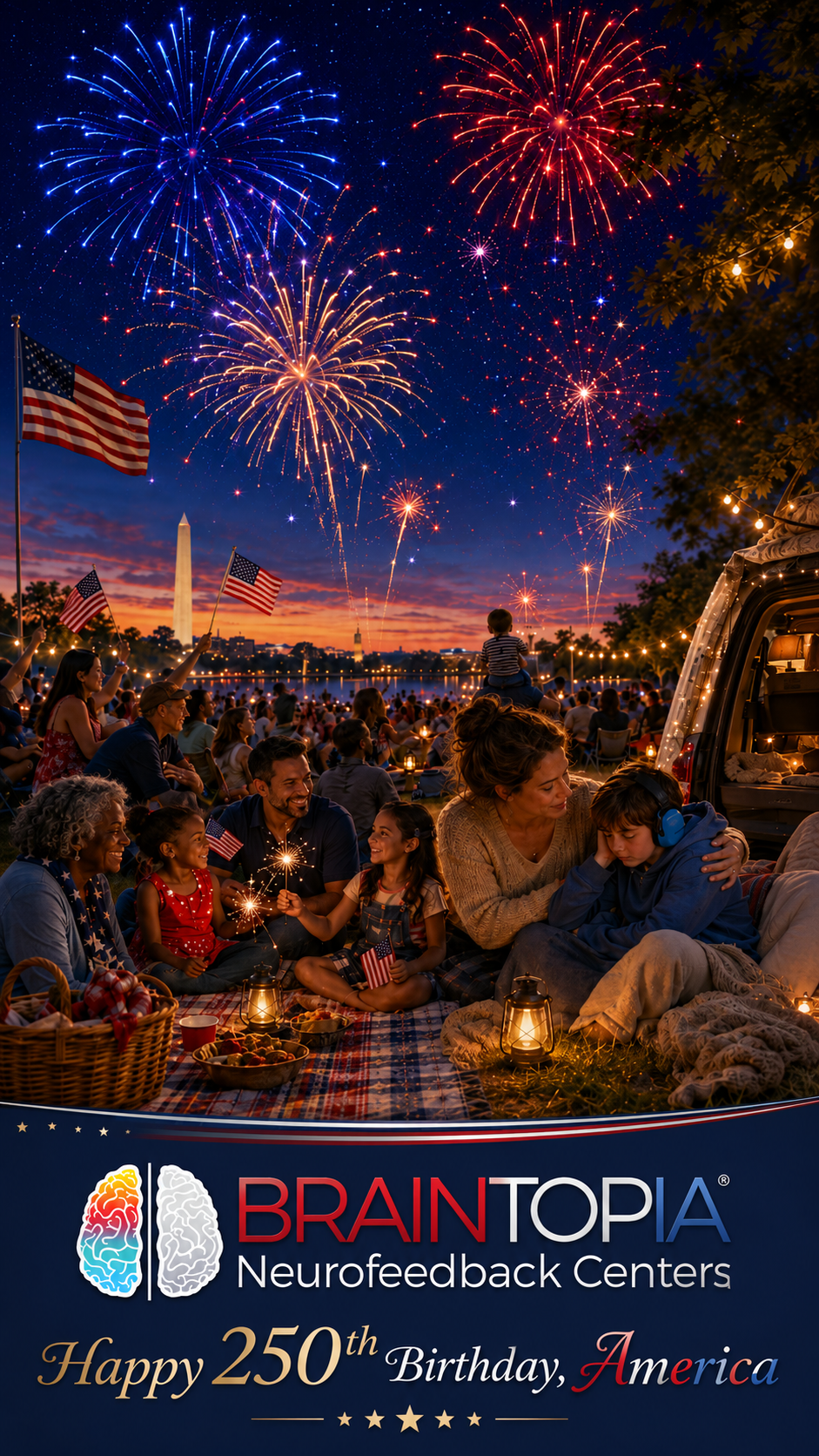
Reflecting on America’s 250th While Supporting Every Brain
Fourth of July has come and gone, and what a milestone it was—America’s 250th birthday!
Communities across the country filled the skies with parades, backyard barbecues, patriotic songs, and spectacular fireworks lighting up the night. For many, it was pure joy: a time to gather with family and friends, cheer, and make lasting memories under the stars.
But for some children, teens, and adults—especially those with autism spectrum disorder (ASD), sensory processing differences, or PTSD—the bright flashes, booming sounds, smoky smells, and crowds can feel like a profound physiological assault rather than a celebration. What’s exciting for one brain can trigger intense distress, a heightened startle response, flashbacks, or a full sensory storm for another.
Why Fireworks Can Feel Like a Sensory Assault
Research helps explain why. Studies on acoustic startle responses show that many children with ASD exhibit hyperreactivity even to weaker sounds (around 85 dB or lower). Reactions to very loud sounds may not differ much from neurotypical groups, but the brain struggles more with filtering everyday or background noise. This is tied to prolonged startle latency—the response is delayed but arrives with greater intensity. (Takahashi et al., 2014)
On top of that, cerebral hyperconnectivity plays a big role. The autistic brain often has extra active connections between regions, like a busy highway with too many merging ramps. Information gets congested instead of flowing smoothly. When a firework explodes, it isn’t just a sound—it can feel like an unfiltered surge of activity. (Coben & Padolsky, 2007)
These differences are not behavioral choices. They are grounded in real neurophysiology, and understanding them helps us respond with compassion instead of frustration.
How Neurofeedback Helps Address the Root
The encouraging news is that the brain can learn healthier patterns. Neurofeedback is a safe, drug-free approach that helps by addressing underlying neural patterns.
Key studies show strong results. In assessment-guided neurofeedback work by Coben & Padolsky (2007), 89% of participants saw overall symptom improvement, with a 40% reduction in core ASD symptomatology (measured by ATEC Total Scores). Importantly, 76% of the group showed decreased cerebral hyperconnectivity, and this change was linked to positive clinical outcomes across behavior, communication, and regulation.
Neurofeedback uses real-time monitoring to help the brain practice producing calmer, more balanced rhythms. It supports better self-regulation so the nervous system can transition more smoothly between high arousal (the “fight-or-flight” feeling from a sudden bang) and calm. For those with PTSD, it helps retrain automatic triggers into manageable cues, teaching the brain that it is safe now—even when a firework sounds like a reminder of the past.
These changes can lead to less anxiety, better focus, calmer emotions, improved sleep, and an easier time handling sensory moments. It provides lasting support that works well alongside other approaches.
Simple Ways to Reflect, Recover, and Prepare for What’s Next
We hope everyone had a wonderful (or at least manageable) Fourth of July, filled with as much joy and connection as possible. Even after the fireworks have faded, the effects of sensory overload can linger. Here are some practical, family-friendly ideas to support recovery and build resilience moving forward:
Debrief and ground — Talk about what went well and what felt tough. Use box breathing (inhale 4 counts, hold 4, exhale 4, hold 4) or a strong sensory reset like sucking on something sour (lemon drop or sour candy) to help bring the nervous system back to the present.
Review and reinforce — Revisit any social stories or picture schedules that helped, and celebrate the small wins. Noise-canceling headphones and “safe zones” aren’t just for the moment—they’re tools worth keeping handy all summer.
Gentle exposure practice — If fireworks videos still feel useful, watch them at low volume as a way to build tolerance gradually in a controlled environment.
Avoid complete avoidance long-term — As experts at the VA National Center for PTSD note, gentle, supported exposure combined with strong regulation tools often helps more over time than total retreat.
These small steps give the brain extra support and choice.
At Braintopia, we believe no one has to navigate these sensory storms or triggers alone. Our personalized neurofeedback programs—guided by a detailed QEEG brain map—help brains of all ages build better regulation, resilience, and calm. Whether you’re supporting a child with ASD, a veteran with PTSD, or anyone feeling overwhelmed by life’s louder moments, we’re here to help your family feel more confident and connected.
We have locations across the Dallas-Fort Worth area, including Addison, Frisco, Plano, and McKinney, plus convenient remote at-home training options.
Ready to take the next step toward a calmer, more resilient brain this summer?
Take our free, confidential quiz on the Braintopia website to see if neurofeedback could be a good fit.
Call us at (972) 640-7022 to schedule a consultation and learn how we can support you.
You deserve to enjoy more of life’s celebrations—with less overwhelm. Let’s carry the spirit of this 250th anniversary forward with greater freedom and ease for every brain.
Wishing you a safe, joyful, and balanced rest of the summer—however it looks best for your family.
